Perforated Sheets & Wire Mesh
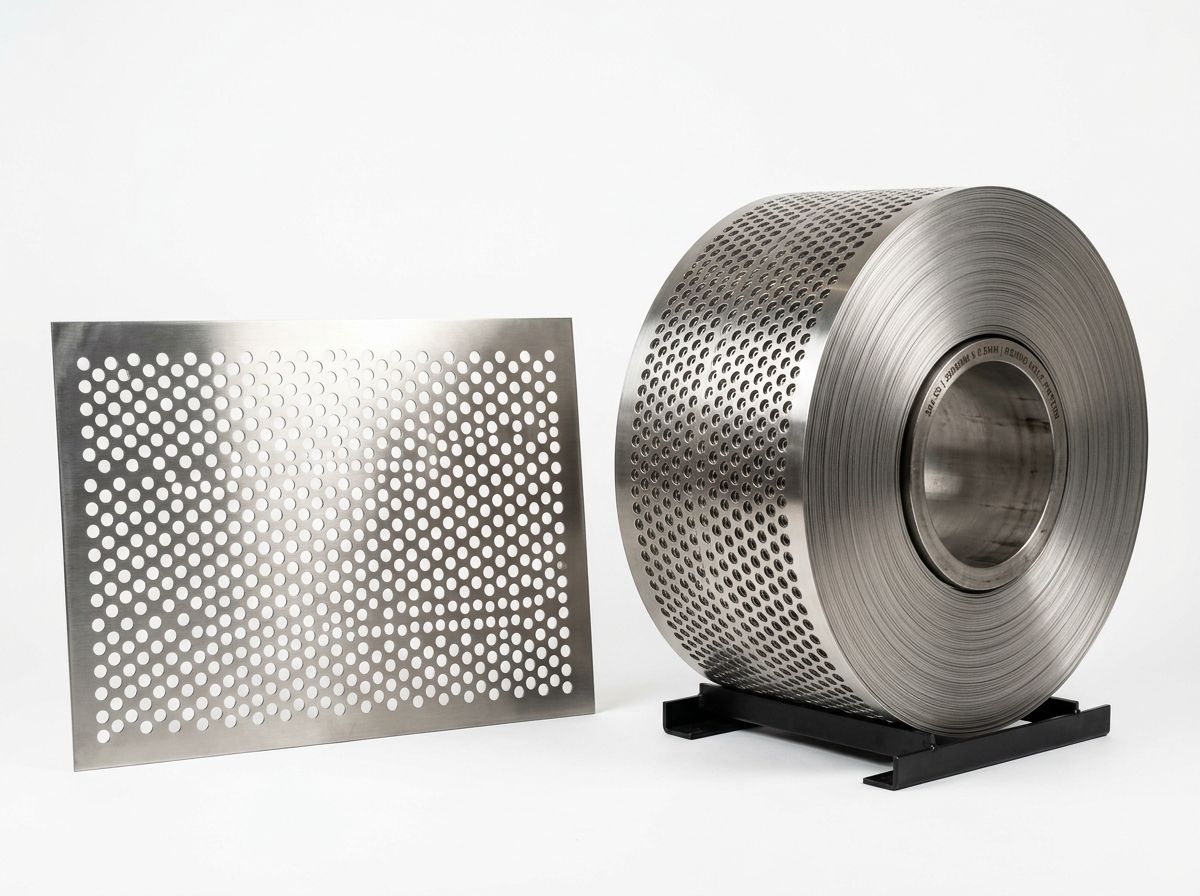
SS Perforated Sheets and Coil
Leading precision manufacturer of stainless, mild, and aluminium perforated sheets & coils. CNC punched for accurate hole spacing, triangular and square pitch options.
- High open area, perfect airflow, and fluid drainage
- Triangular (60°/45° staggered) & Square Pitch systems
- Materials: SS 304, 316, Alloys, and customized sizes
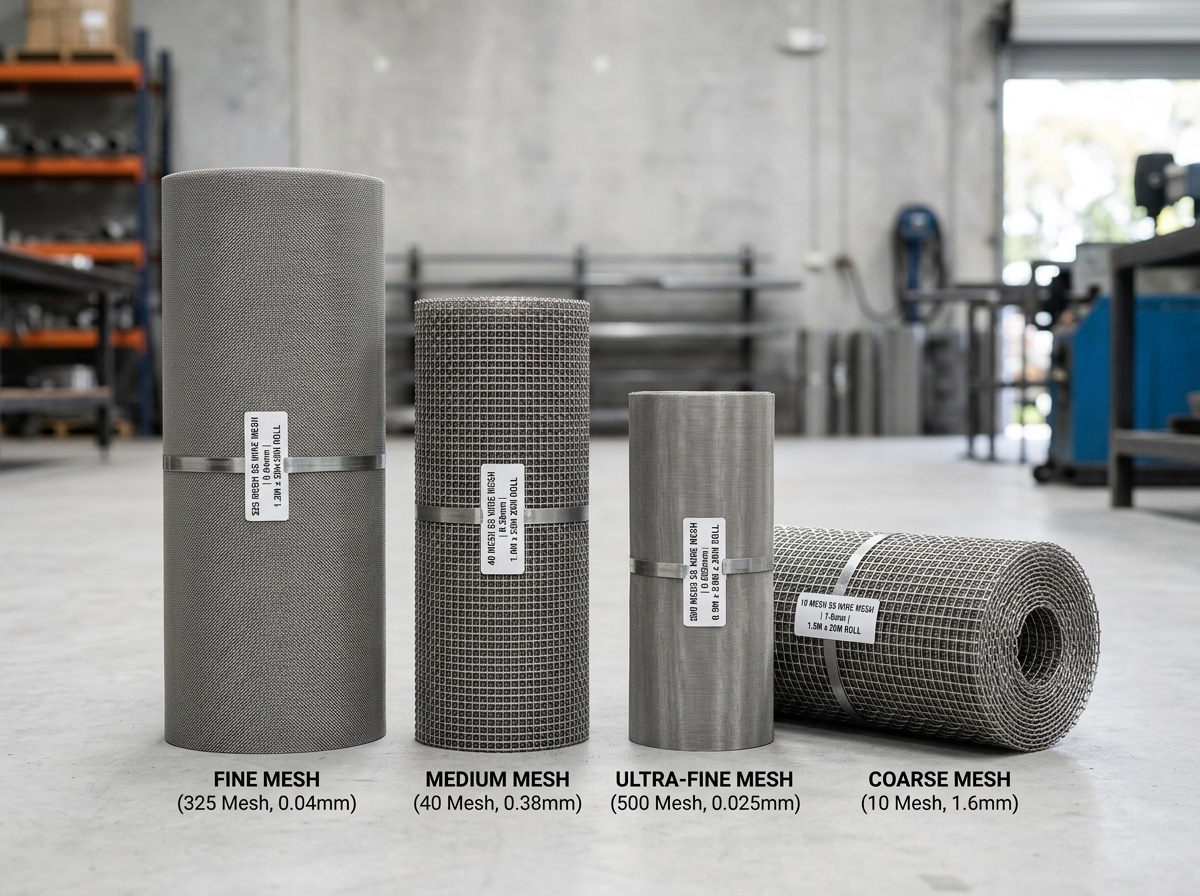
SS Woven Wire Mesh & Screens
Industrial filtration screen and protection sieves. Offering premium quality stainless steel wire mesh rolls weaved from mesh 4 to 500 with 100% uniformity guarantee across the roll.
- Micro Weaving: Mesh 4 to Mesh 500 custom capabilities
- Premium Quality Filtration accessories built since 1998
- Rigid quality parameters checked for PET & BOPP extruders
Mesh Count & Aperture
The mesh count (number of openings per inch) and aperture size (size of each opening) directly determine the filtration level of stainless steel wire mesh. A higher mesh count with smaller apertures allows finer filtration, while a lower mesh count with larger openings is used for coarse filtering. Industries like pharmaceuticals, chemical processing, and food production often require fine mesh to separate tiny particles with high accuracy.
Selecting the right mesh count and aperture size ensures consistent product quality, efficient processing, and regulatory compliance across various industrial applications.
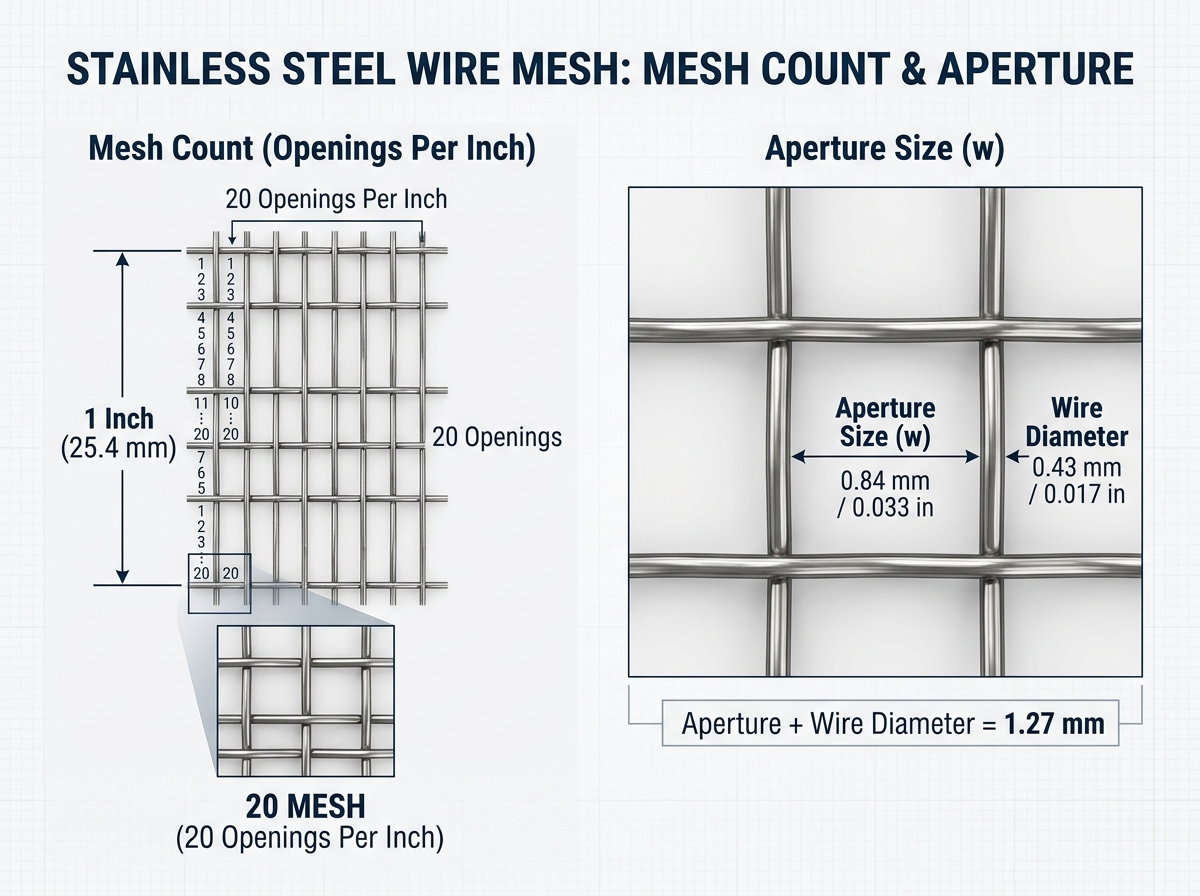 Visual Guide: Weave Count vs Aperture Microns Sizing
Primary Stainless Steel Alloys Weaved
This is the most commonly used grade material. It’s strong, durable, and resists rust and corrosion well. Ideal for everyday industrial and commercial uses.
A step above SS 304, this mesh handles harsh chemicals, saltwater, and high heat better. It’s perfect for tough environments like chemical plants or coastal areas.
This is a low-carbon version of SS 316. It offers even better corrosion resistance, especially after welding. It’s used in sensitive applications like food processing, pharmaceuticals, and marine industries.
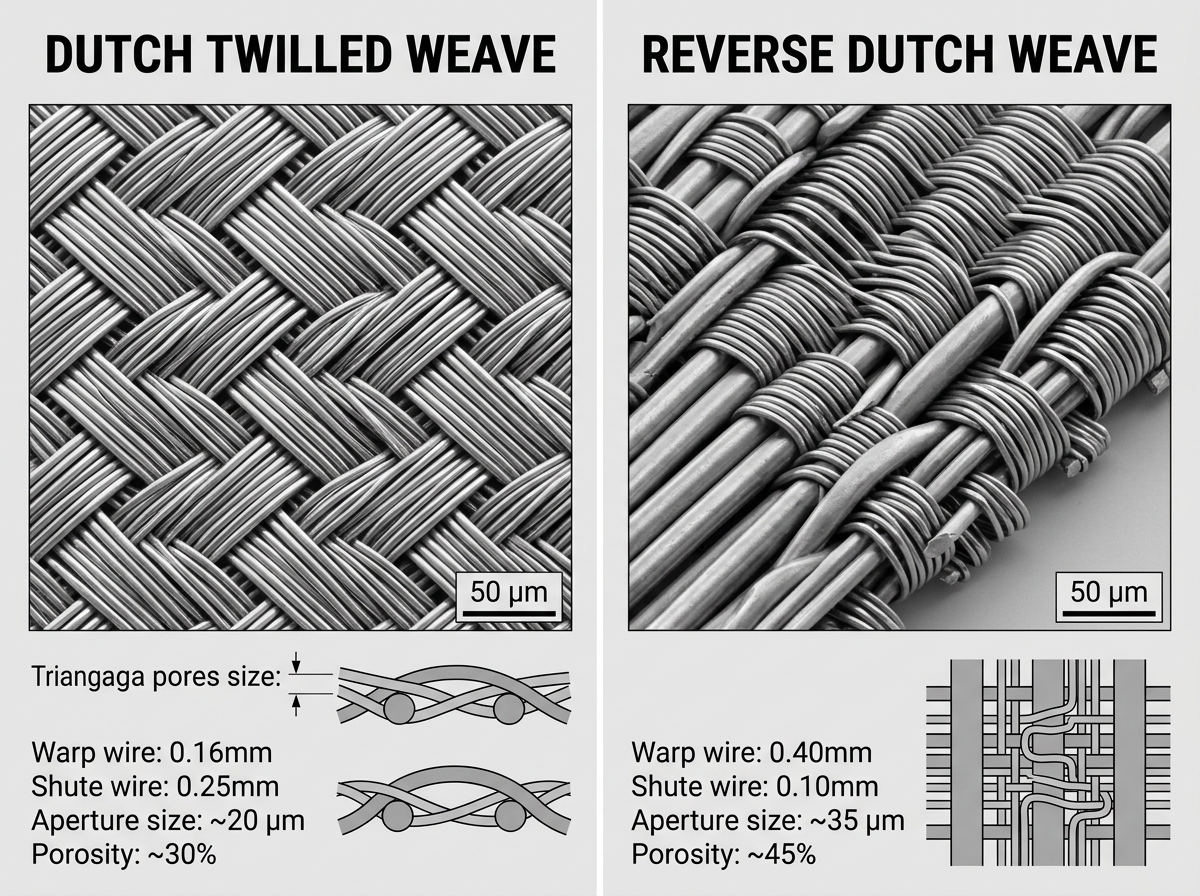 Visual Comparison: Dense Dutch Twilled Weave vs Reverse Dutch Weave
High-Density Dutch Weave Methods
Dutch Twilled Weave
In this weave, weft wires are thicker and packed tightly together, warp wires are thinner and spaced farther apart. Each (warp) wire goes over two (weft) wires and under two (weft) wires, creating a twilled pattern.
- Used for ultra-fine filtration
- Extremely strong under high pressure
- No visible holes – filters similarly to cloth
- High pressure hydraulic systems
- Aerospace fuel filters
- Standard plastic extrusion
Reverse Dutch Weave
A special type of Dutch weave where the thicker wires go across, and finer wires run along the length – the reverse of normal Dutch weave. Reverse Dutch Twilled weave (RDTW) combines a reverse Dutch wire (closely spaced warp wires with thinner weft wires) and a Twill pattern (2/2 interlacing). This creates a dense, tortuous path for particles, enhancing filtration precision while maintaining structural stability.
- Significantly increases mesh strength
- Filters minute, microscopic particles
- Handles high pressure filtering machines
- Premium polymer extruder screens
- Heavy pressure filters
- High-flow industrial separation
| Technical Parameter | Standard Specifications Range |
|---|---|
| Product Categories | SS Perforated Metal Sheets, Stainless Woven Wire Mesh, Vibrating Screens, Hexagonal Wire Net, Crimped Mesh |
| Mill Thickness Range | Sheets: 0.3 mm to 10.0 mm | Mesh Wire Gauge: 0.02 mm up to 4.0 mm |
| Hole Array Shapes | Round Pattern, Square Matrix, Triangle Pattern, Hexagonal Honeycomb, Rectangular Slotted / Capsule holes |
| Hole Diameter Pattern | 0.5 mm up to 75 mm dynamic sizes and spacing pitches |
| Wire Mesh Densities | 1 mesh, 2 mesh, 5 mesh, 10 mesh, 20 mesh, 50 mesh, 100 mesh, 200 mesh up to 500 ultra fine filtration meshes |
| Principal Alloys/Grades | Stainless Steel 304, 304L, 316, 316L, 316Ti, 321, 310S, 430, Duplex UNS S31803, Hastelloy, Monel Alloys |
| Width & Length Dimensions | Standard sheet sizing 4ft x 8ft (1220mm x 2440mm), 1000mm x 2000mm, or dynamic length rolls |
| Standard Design Codes | ASTM A240 (for plates), ASTM E2016 (for industrial woven wire cloth) |
Quality Assurance & ISO Manufacturing Standards
Our perforated sheets are fabricated with state-of-the-art CNC punching machinery, resulting in completely clean holes, zero burrs, and pristine flat structural dimensions. We perform thorough quality audits, ensuring stable aperture spacing and wire thickness:
- Zero-Burr Guarantee: High precision deburring treatment on both faces of punched plates.
- Perfect Pitch Tolerance: Critical control of margins and geometric distance arrays in perforated holes.
- Aperture Verification: Strict verification of wire mesh filtering openings using high-zoom digital optical microscopes.
- Quality Certifications Provided: EN 10204 3.1 Mill Test Records, Chemical Composition and UTS testing documents.